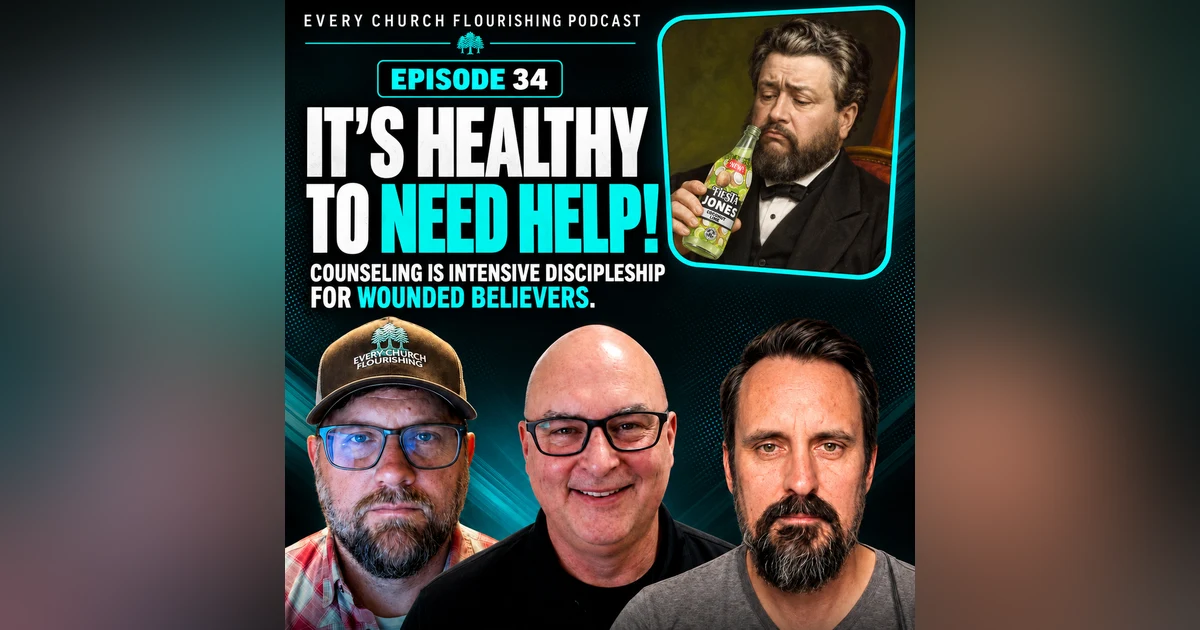
It’s Healthy To Need Help! Counseling is Intensive Discipleship for Wounded Believers. What are signs that you should talk to a counselor?

 Apple Podcasts
 Spotify
 Amazon Music
 YouTube
 Youtube Music
 iHeartRadio
 Podchaser
 JioSaavn
 Castbox
 Gaana
Gaana How to get in touch with Jason Kovacs and Gospel Care Collective:
https://www.gospelcarecollective.com/counseling/jason-kovacs/
How Jesus in the Garden models for us the need to share our burdens, pains, and needs with other believers rather than bottle them up.
What are signs and symptoms that your anxiety or stress has gone beyond the point where you can handle it on your own?
What are some signs in a leader’s life that they are close to a breakdown? What are signs that you should talk to a counselor sooner rather than later?
We want to bring the whole Word of God applied with full care to the whole being in a way that is consistent and not oppositional to where we can find truth.
How can churches and pastors make the time to adequately counsel those in the congregation who need counseling help?
We do counseling in church because God cares for His church, and counseling the hurting is a reflection of God’s heart.
Counseling the wounded and hurting is like intensive, focused discipleship.
Hosts: Dr. Chase Thompson & Pastor Christopher Cole
Guest: Jason Kovacs (Counselor, Gospel Care Collective)
================================================================================
PART 1: WELCOME & INTRODUCTION
================================================================================
DR. CHASE THOMPSON:
We're talking with Counselor Jason Kovacs today, and I think it's a really good, thoughtful conversation. He talks about, in particular, how biblical counselors can utilize some insights from secular counseling or even the world of psychology. But the most important thing is—
JASON KOVACS:
We have to be really vigilant and careful to say, no, the gospel is the main thing. Jesus is the center. Everything else serves that: the purpose of glorifying God and inviting and drawing people into finding their deepest enjoyment in Him.
ANNOUNCER / INTRO VOICEOVER:
Soul care, and resources that work together to build up your local fellowship and the broader kingdom of God. Join hosts, Pastor Chris Cole and Dr. Chase Thompson from the Great Commission Association, led by Dr. Mike Stewart, as they explore the frontiers of ministry and aim for the goal of making every church flourish.
DR. CHASE THOMPSON:
Hello again, everybody, and welcome into episode number 34 of the Every Church Flourishing podcast sponsored by the Great Commission Association of California. We are a family of Jesus-loving, Bible-loving churches in the Central California area.
If you are anywhere near us and you're a church or leader looking for partnership and a family to belong to, I want to point you to our website: gcasbc.org. We've got all kinds of great things going on. We encourage each other, have workshops and conferences, and several of those I will tell you about at the end of the broadcast today.
We have counselor Jason Kovacs on with us today. It's the second part of a two-part interview that my co-host, Pastor Christopher Cole, and I began last week. I think this is just a fantastic discussion about the role of counseling in the church and how churches can better care for hurting people. We're going to touch on broad things like overcoming anxiety, dealing with stress, and things like that, but we're also going to talk about how church leaders can really help their people.
We begin today by talking to Jason about how he went from being a pastor to a counselor.
================================================================================
PART 2: FROM PASTORAL MINISTRY TO COUNSELING
================================================================================
DR. CHASE THOMPSON:
Along those lines, Jason, you became a counselor by way of being a pastor and probably seeing how much need there was in the church for more intense, additional counseling. How did that transition happen? What did you see? How did God make you aware of this step in your life to move from pastoral ministry into counseling ministry?
JASON KOVACS:
Apart from God in His providence leading me, it simply wasn't my plan. But God's plan is better, wiser, and more loving than mine. If I was in charge of my life, I don't know where I'd be.
What God used was what I saw in different settings: the church cared, and they wanted to care. It wasn't a question of, "Is care for people a value of yours?" Absolutely. I can't think of a church that didn't sincerely care for people. But what I did see is that they didn't necessarily know *how* to care, or they didn't have the structure and systems to effectively and sustainably care for people. The churches were either too big, felt too big, or felt too small.
There were so many other good things taking up time, attention, and capacity. I also saw this idea that good theology should be enough, which left a real gap in practical pastoral care. I believe deeply in good preaching—that's really important. But so is pastoral care.
Proclaiming the gospel publicly and then ministering the gospel personally—you see that in the Apostle Paul. He proclaimed the gospel publicly, teaching from house to house. In Paul's letters, there is so much personal relationship. Think of all the names Paul includes in his letters; these were people he knew personally. As a missionary apostle, he had every excuse to stay detached from personal situations, but Paul had a pastor's heart, God's heart, and he got involved in people's lives.
I saw a gap where that was missing, and God used that to stir my heart. I discovered some gifting and passion in that area, and God opened doors for me to step into providing care and helping the church develop a vision and equip people.
================================================================================
PART 3: GOSPEL-CENTERED & CLINICALLY INFORMED
================================================================================
DR. CHASE THOMPSON:
Well, let's dance around with controversy for a moment. In doing some research on your bio, your counseling approach is described as "gospel-centered, clinically informed." Some people hear that word "clinical" and wonder what's going on. Twenty or twenty-five years ago, any idea of blending psychology and biblical counseling would have caused an upset stomach for some.
Yet Pastor Christopher mentioned earlier the Puritans, like Richard Baxter in the 1600s, who had a remarkably modern view of mental health despite being thoroughly biblical. And Spurgeon addressed severe depression boldly.
Talk about how counseling can incorporate clinically informed ideas while remaining gospel-centric, Bible-following, and faithful. How do you blend those things?
JASON KOVACS:
It still turns stomachs today—it’s a very current debate. It’s important for us to talk through this.
In my approach, I put "gospel" before "clinical," and that's very purposeful. The foundation of the gospel and God's Word is first. That is the lens through which we look at and interpret everything. Clinical insights do not stand side by side on equal footing or with equal authority with theology.
Part of the debate is that critics say, "By bringing in anything clinical, you are integrating competing authorities." But my stance is that God's Word and the gospel have ultimate, governing, and foundational interpretive authority.
At the same time, through common grace and science, there are things we have learned about humanity, physiology, and how we operate in this world. There is real value in looking at those observations through the lens of God's design. Any clinical insights serve the biblical counseling task; they do not replace Scripture or sit alongside it as co-interpreters. That is what distinguishes this from integrationism.
Furthermore, biblical counseling must take seriously that we are not just souls—we are bodies. Caring for the whole person means considering how the physical and spiritual interact. We want to be clinically informed, not clinically grounded or driven. The gospel is always the main thing; Jesus is the center.
DR. CHASE THOMPSON:
Amen. As someone who would have been skeptical five or ten years ago, I'd say to my skeptical brothers and sisters: keeping the gospel dominant while incorporating common-grace insights is no different than taking an ibuprofen for a migraine or casting a broken arm. Just because medical or psychological concepts can be abused doesn't mean they aren't common grace.
PASTOR CHRISTOPHER COLE:
Amen. One of the things that has been so refreshing is acknowledging our need for humility outside our normative scope of practice. I have an MDiv, I've read widely, and I feel comfortable going head-to-head talking Bible with anyone. Yet there is so much common-grace knowledge I don't possess.
At a conference a couple of years back, an example was given of a combat veteran dropping to the ground when a car backfires. A hyper-biblicist model might say, "He has a fear problem, and fear is sinful." But the reality is, his amygdala fired faster than his cognitive prefrontal cortex could recite Scripture because of post-traumatic stress. In an MRI machine, you can see the prefrontal cortex literally turn off.
I appreciate an approach that brings the whole Word of God applied with full care to the whole being, in a way that respects the truth God allows us to discover about the human body and mind.
================================================================================
PART 4: BUILDING A CULTURE OF CARE IN THE LOCAL CHURCH
================================================================================
PASTOR CHRISTOPHER COLE:
Jason, imagine a pastor leading a church of 50 to 150 people listening right now. He’s thinking, "I have so many needs—anxious members, unresolved grief, marital conflicts. I have no time, no money, no counseling staff, and few reliable volunteers, and I have a sermon to prepare every week." What does that pastor do to build a system and culture of care?
JASON KOVACS:
You've just described probably 90% of churches. I meet pastors all the time in that exact situation. For many, counseling ministry feels like number ten on a top-ten list of urgencies.
First, understand that counseling and care are not separate, optional ministries—they are discipleship. It is focused, intensive discipleship. When you view personal ministry alongside public preaching as discipleship, its biblical necessity becomes clear.
Second, recognize your capacity and competency, and trust God with your limitations. Walk in compassion, but be okay with starting small. Jesus knew His human limitations; there were times crowds sought healing and He chose to move on to other towns. Jesus was the only perfect counselor who ever lived, and many people still didn't receive His counsel!
So, faithfully do what you can: preach the gospel, pray with people, and care personally for those within your capacity. Pray for God to raise up others with this calling. Talk about care from the pulpit so members realize they can be involved. Bring someone along when visiting the sick so they can learn.
Finally, build relationships with trusted counselors or ministries like the Gospel Care Collective. We exist to partner alongside pastors, consulting on complex cases and carrying some of the heavy, ongoing weekly care that pastoral bandwidth doesn't permit.
================================================================================
PART 5: WARNING SIGNS OF BURNOUT IN PASTORS
================================================================================
DR. CHASE THOMPSON:
Jason, you spend a lot of time counseling pastors and ministry leaders. What are some warning signs that a leader is approaching burnout, emotional collapse, or breakdown, rather than just routine fatigue?
JASON KOVACS:
Paul tells pastors to keep watch over their own souls. Consider Jesus in the Garden of Gethsemane: He was deeply troubled in His soul to the point of death, falling to the ground and sweating drops of blood. If we observed someone experiencing that today, we might think they were having a severe panic attack. Yet Jesus openly invited His closest friends—Peter, James, and John—saying, "Come, watch and pray with me," sharing His internal struggle.
For pastors, warning signs often include:
1. Disconnection & Isolation: Insulating yourself, feeling profoundly lonely, having no close relationships where you are truly known, and fearing letting anyone in.
2. Emotional Numbness: Feeling hollowed out, losing ministry passion, waking up every morning with constant anxiety, or feeling like you're spinning your wheels.
3. Unusual Reactivity: A sudden drop in emotional resilience where irritability, anger, and resentment spill out in unexpected ways.
Every pastor needs people who know them completely—their fears, temptations, and struggles—without judgment or shame.
DR. CHASE THOMPSON:
What indicates that someone's anxiety, depression, or stress has gone beyond what they can handle alone?
JASON KOVACS:
If you are asking yourself, "Can I deal with this alone without telling anyone?"—that thought itself is a clear sign you need to tell someone.
Hebrews 3 instructs believers to exhort one another daily so no one is hardened by sin's deceitfulness. We are prone to wander and prone to suffer. Needing help is not a failure; it is normal, healthy, and a sign of spiritual maturity.
I think of a 25-year-old major league baseball catcher recently who had a rough game with communication errors. His manager and veteran teammates came out to coach and encourage him. In the post-game interview, the player expressed embarrassment, saying, "I'm 25, I shouldn't need that." It broke my heart because that mentality convinces pastors and leaders that needing help is unacceptable. Needing support is biblical.
================================================================================
PART 6: KNOWING WHEN TO REFER
================================================================================
PASTOR CHRISTOPHER COLE:
When does a pastor acknowledge that a situation is beyond his ability and call in outside help—whether consulting a ministry like the Gospel Care Collective or referring someone to a medical psychiatrist?
JASON KOVACS:
Pastors must weigh three factors: Capacity, Competency, and Complexity.
Compassion alone is not enough. You can love someone deeply, but if their problem requires intensive clinical, medical, or psychiatric care, trying to be their sole counselor will lead to burnout and can cause harm.
Pastors should have trusted partners they can call for consultations. We regularly consult with pastors, advising on practical steps or stepping in to handle complex situations while the pastor continues to shepherd the person's soul.
================================================================================
PART 7: A 60-SECOND EXHORTATION ON ADOPTION
================================================================================
DR. CHASE THOMPSON:
Jason, you have adopted children. In 60 seconds, what should the church know about adoption?
JASON KOVACS:
James 1:27 tells us that pure and undefiled religion before God is to visit orphans and widows in their affliction. God's heart throughout Scripture is to care for the fatherless and lonely.
I pray for the day when there is no waiting list of children in foster care, but rather waiting lists of Christian families ready to open their homes.
However, notice James specifically says "in their affliction." Caring for orphans involves real brokenness, trauma, and lifelong complexities. As churches grow in holistic soul care, they become far better equipped to support adoptive families and care for the most vulnerable among us.
DR. CHASE THOMPSON:
Thank you, Jason! Listeners can find Jason Kovacs at gospelcarecollective.com or through the links in our show notes.
================================================================================
PART 8: UNCOMMON SODA REVIEW (FIESTA JONES COCONUT LIME)
================================================================================
DR. CHASE THOMPSON:
Now it's time for another uncommon soda review! Today Pastor Christopher and I are reviewing Fiesta Jones Coconut Lime Craft Soda. Christopher, what made you look forward to this one?
PASTOR CHRISTOPHER COLE:
The packaging is fantastic—a sleek aluminum twist-cap bottle. Plus, I love lime, I love coconut, and the concept brings to mind that famous Harry Nilsson song.
DR. CHASE THOMPSON:
Cracking mine open... The first thing that jumps out is the appearance. This is crystal clear—clearer than tap water, with virtually no visible bubbles.
PASTOR CHRISTOPHER COLE:
(Opening with a cloth for grip) It has a subtle lime scent. Let's taste!
DR. CHASE THOMPSON:
Whoa—much stronger punch than anticipated! It is very lime-forward.
PASTOR CHRISTOPHER COLE:
Very lime-forward, followed by a toasted coconut note. But there’s a noticeable bitter aftertaste.
DR. CHASE THOMPSON:
Looking at the label, it has cane sugar but also stevia. That stevia finish is quite pronounced, and the lime completely overpowers the coconut.
PASTOR CHRISTOPHER COLE:
I use stevia every morning, but here the combination feels off. If offered this on a hot beach, I'd sip it politely, but I wouldn't request a refill.
DR. CHASE THOMPSON:
I'd probably keep the aluminum bottle for water, but leave the soda behind.
FINAL RATINGS (Out of 5 Spurgeons):
- Pastor Christopher Cole: 2.0 Spurgeons
- Dr. Chase Thompson: 2.0 Spurgeons
================================================================================
PART 9: WRAP-UP & UPCOMING EVENTS
================================================================================
DR. CHASE THOMPSON:
A rare 2.0 Spurgeon rating, but an honest review!
Be sure to visit gcasbc.org for upcoming Great Commission Association events, including our Annual Missions Conference in Seaside, California, October 9th–10th. You can also find us at everychurchflourishing.com.
Thank you for listening, and Godspeed!